comparisons
Infrared vs Traditional Sauna: Which Is Right for Your Home?
Infrared vs traditional sauna: heat profile, install requirements, operating cost, health research, and which suits which household.
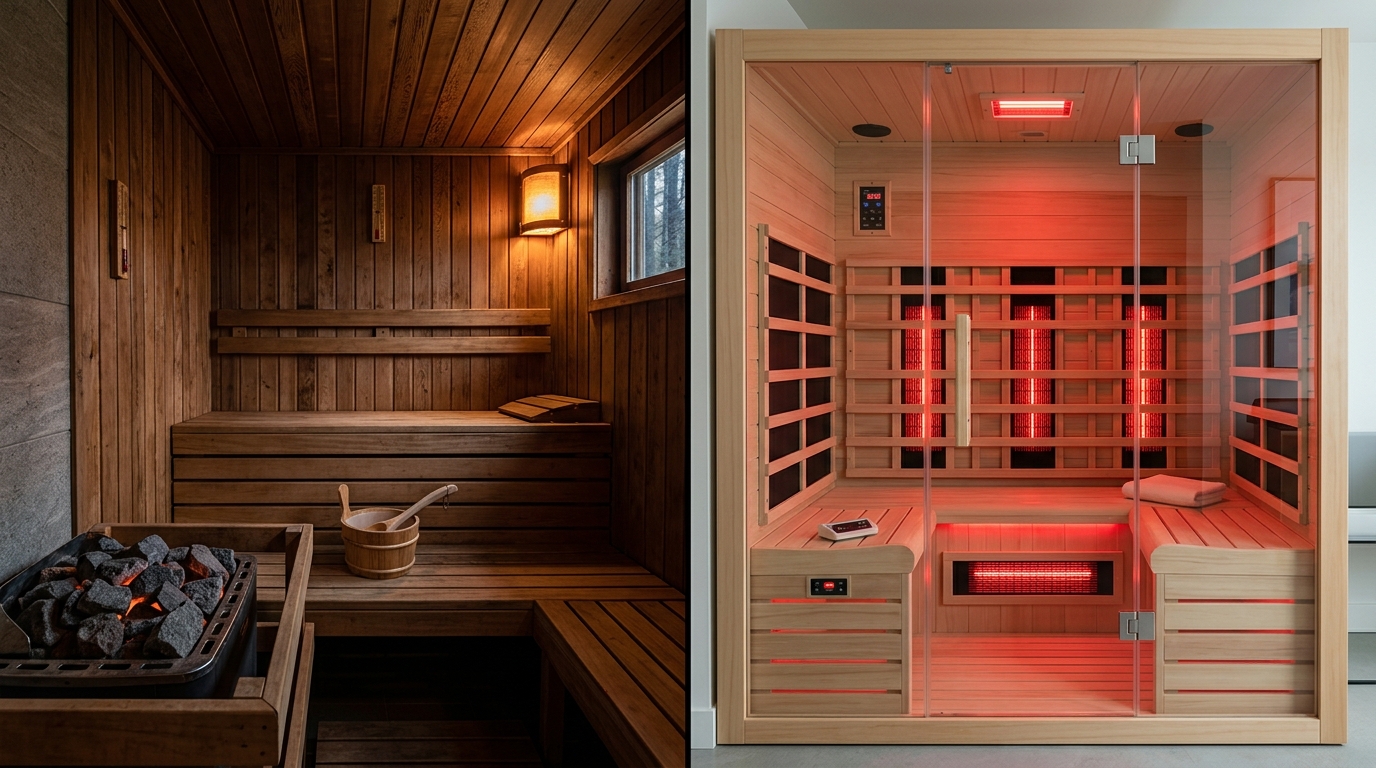
The “infrared vs traditional sauna” question gets asked thousands of times a month, and most of the answers online frame it as one product being better than the other. They’re not better or worse — they’re different products that share a name. A Finnish-style traditional sauna and a carbon-panel infrared cabin produce different experiences, suit different installs, and cost different amounts to run. Picking the right one for your situation is a matter of matching your specific constraints to the format’s specific trade-offs.
Here’s the comparison, straight.
The fundamental difference
A traditional sauna heats stones with an electric or wood-fired stove until the stones reach 600-700°F. The stones radiate heat into the air, the air heats to 180-195°F, and the hot air heats you. When you pour water on the stones, the water flashes into steam — löyly — which briefly raises the perceived temperature and humidity dramatically.
An infrared sauna skips the air. Carbon or ceramic panels in the cabin walls emit infrared wavelengths (5-15 micrometers) directly. Your skin absorbs the infrared. Your body heats up. The air in the cabin stays around 130-145°F — warm, but not hot enough to feel oppressive on its own.
That difference cascades into everything else.
Direct comparison
| Product | Best for | Rating | Notes | |
|---|---|---|---|---|
| Operating temperature | Traditional: 180-195°F. Infrared: 130-145°F. | — | Traditional is hot air; infrared is direct body heating. | — |
| Heat-up time | Traditional: 30-45 min. Infrared: 15-20 min. | — | Mass of stones vs lower target temp. | — |
| Electrical requirements | Traditional: 240V dedicated. Infrared: usually 110V. | — | Traditional heaters draw 6-9 kW; infrared 1.5-2.5 kW. | — |
| Per-session operating cost | Traditional: ~$0.80-1.20. Infrared: ~$0.20-0.35. | — | At $0.16/kWh national average. | — |
| Install cost (beyond cabin) | Traditional: $400-1,200 (electrician). Infrared: $0. | — | Traditional needs a dedicated 240V/40A circuit. | — |
| Löyly (steam burst) | Traditional: yes. Infrared: no. | — | You cannot pour water on infrared panels. | — |
| Best for daily use? | Traditional: ritual/social. Infrared: convenient daily. | — | Heat-up time often decides which one gets used. | — |
| Footprint indoor | Traditional: 30-60 sqft. Infrared: 12-36 sqft. | — | Traditional needs venting space. | — |
When traditional wins
Choose a traditional sauna if:
- You grew up with sauna, used them in Finland or northern Europe, or know from gym/spa use that the high-heat ritual is what you want.
- You can dedicate a basement room or outbuilding, and you have or can install a 240V/40A circuit.
- You want the löyly experience — the steam burst from water on hot stones — which is the defining moment of Finnish sauna and cannot be replicated in infrared.
- You plan to use sauna socially as well as solo; the higher operating temp suits groups and tolerates door-opening better.
- You don’t mind a 30+ minute pre-heat for each session.
When infrared wins
Choose an infrared sauna if:
- You want sauna as a daily habit and convenience matters more than ritual depth — a 15-minute heat-up is the difference between using it five times a week and using it once.
- You’re installing indoors in a finished room, closet, or finished basement without major renovation.
- You’re working with standard 110V wiring and don’t want to budget for an electrician.
- Your sessions will mostly be solo or two-person; the lower ambient air temp suits longer 45-minute sessions.
- You want lower operating cost — roughly a quarter of traditional per session.
When portable wins (a third option)
If you rent, live in an apartment, or aren’t sure you’ll stick with the habit, neither answer above fits — you should look at a portable pod or blanket at the $400-800 tier instead. Test the daily ritual first; upgrade once it sticks.
What the research actually says
Both formats have meaningful health research behind them. The strongest evidence is for cardiovascular benefits:
- Traditional sauna: the often-cited Finnish cohort studies (Laukkanen et al., 2015 onward) followed thousands of middle-aged men and found significant reductions in all-cause mortality and cardiovascular events among 4-7-times-weekly users. These studies are observational, not randomized — they show association, not causation — but the effect size is large and consistent across follow-ups.
- Infrared sauna: smaller clinical trials (mostly Japanese, some U.S.) show measurable improvements in blood-pressure response, endothelial function, and chronic-pain markers from 3-5 weekly sessions of 30-45 minutes. The studies are smaller than the Finnish cohort work but the cardiovascular markers move in the same direction.
The honest summary: both formats produce real physiological effects. The Finnish work is more famous because it’s larger and older. There isn’t strong evidence that one format outperforms the other on health outcomes — what matters is consistent use, which favors whichever format you’ll actually use frequently.
The “detox” claims marketed by some manufacturers (heavy metals, “toxins”) are not well-supported by clinical evidence for either format. Buy a sauna for cardiovascular response and recovery, not for detox.
Direct picks
Best infrared cabin for indoor install
Best for people who want daily sauna in a normal house with a standard outlet
2-Person Indoor Infrared Cabin (carbon, low-EMF)
The 2-person indoor infrared is the highest-leverage product in the home sauna category. Plug-and-play, 16 square feet, sub-20-minute heat-up, and roughly $0.25 per session to run. If you're new to home sauna and you want it to actually become a daily habit, this format gets used more than any other.
★★★★★ (1,850 reviews)
Check current price on Amazon →Best traditional electric sauna
Best for people who know they want the real Finnish-style high-heat ritual and have the 240V install path
3-Person Traditional Electric Sauna (6kW, cedar interior)
The 6kW heater is the right size for a 3-person cabin — large enough to hit 195°F with the lid closed, small enough to be safe in a residential install. Cedar interior, real igneous-rock stones (sauna kiuas), and a standard heater format mean replacement parts are easy to source in year 5+.
★★★★★ (620 reviews)
Check current price on Amazon →Best outdoor — barrel sauna (wood-fired or electric)
Best for backyard install where the traditional high-heat experience is the goal
Outdoor Barrel Sauna (Western Red Cedar, 4-6 person)
The barrel format works particularly well for traditional saunas because the curved walls allow for shorter heat-up times and the geometry sheds rain and snow without a separate roof structure. Wood-fired option is genuinely satisfying for owners with a yard — electric is the lower-friction default.
★★★★☆ (310 reviews)
Check current price on Amazon →FAQ
Frequently asked questions
Can I get both — infrared and traditional?
Is one safer than the other?
Which uses less electricity?
Does an infrared sauna really not feel like a sauna?
What about hybrid saunas that do both?
Bottom line
Want the daily habit, indoor install, lower cost, less friction? Infrared.
Want the authentic high-heat löyly experience, are willing to dedicate a room and 240V circuit, and care more about ritual depth than convenience? Traditional.
Not sure if sauna is going to stick at all? Portable first, then decide.
Use our home sauna cost guide to budget the right tier in either category.