roundups
Best Portable Saunas: Pods, Tents & Blankets (2026)
Portable home sauna picks under $1,000 — pod tents, sit-up cabins, and infrared blankets. For renters, apartments, and try-before-you-commit buyers.
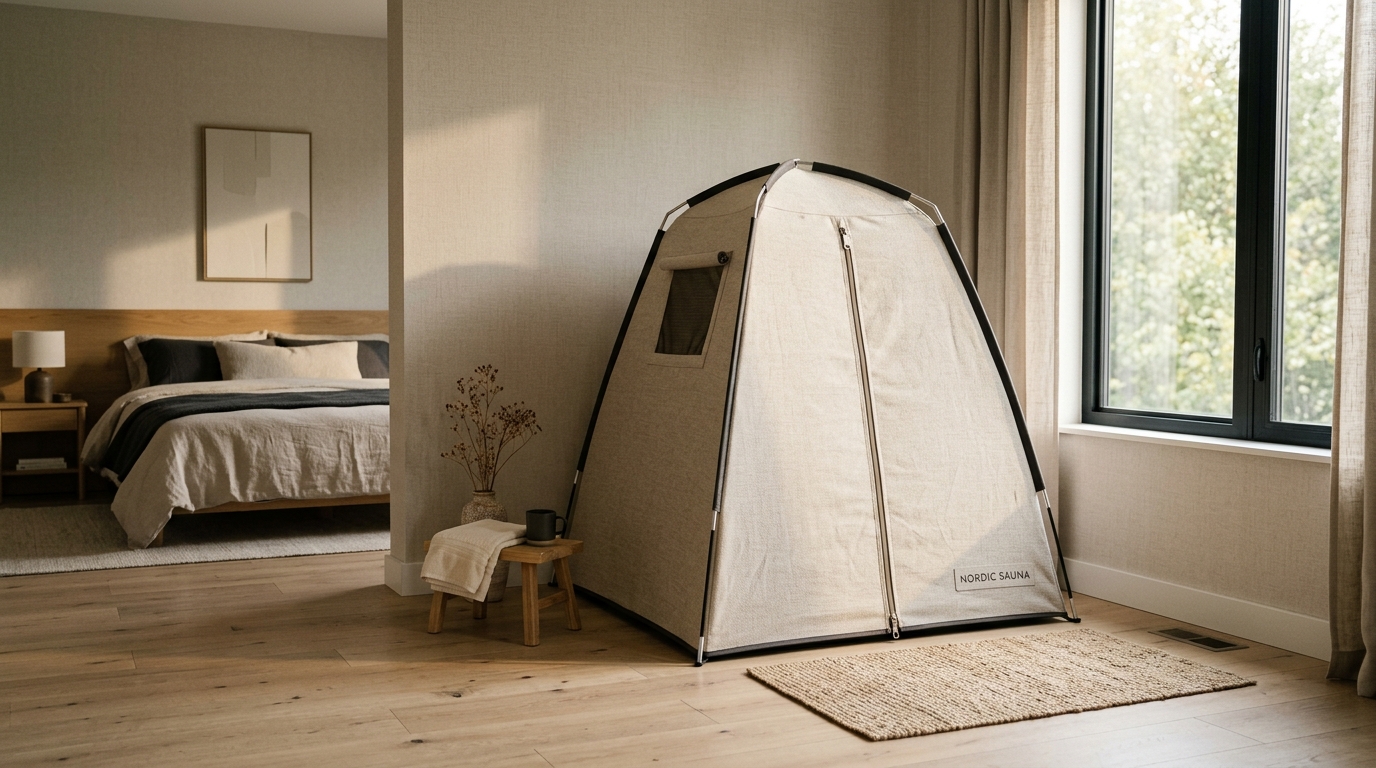
If you’re renting, living in an apartment, or just not ready to spend $3,000 on a permanent install, a portable sauna is a real product — not a compromise. The category has three formats: pod tents (you sit in a fabric cabin with your head sticking out the top), sit-up cabins (zippered fabric box around a chair), and infrared blankets (you lie flat inside a heating pad with a hole for your head). Each makes different trade-offs, and the right one depends entirely on how you’ll use it.
This is a $300-$1,200 category. Below $300 you’re buying a heating pad shaped like a tent; above $1,200 you should be looking at a permanent infrared cabin instead.
When portable is the right answer
Portable saunas earn their place in three specific situations:
- You rent. Permanent saunas need installation, modify electrical, and are not landlord-friendly. Portables fold flat in a closet.
- You’re testing the habit. Daily sauna is a real commitment. 30-45 minutes is meaningful time. Spending $500 to find out whether the ritual sticks is rational; spending $3,500 is less so.
- You travel and want to maintain a routine. Sauna blankets fit in a suitcase. Some pods break down to a duffel bag.
Outside those situations, a fixed infrared cabin is the better value per session over a 5-10 year horizon.
Quick comparison
| Product | Best for | Rating | Notes | |
|---|---|---|---|---|
| Pod tent (head-out) | most users, daily home use, ability to scroll/read during session | ★★★★☆ | $300-700. Storage: 12×18×4 in closet. | Check price |
| Sit-up cabin (zipper) | tallest users, slightly more room, indoor look | ★★★★☆ | $400-900. Bulkier; harder to break down. | Check price |
| Infrared blanket | travel, side-sleepers, side-sleeping during session | ★★★★☆ | $400-1,200. Lay-flat, full-body wrap. | Check price |
| Personal sauna chair (avoid) | nothing — skip this category | ★★★☆☆ | Under $200. Film heaters, plastic walls. Skip. | Check price |
The picks
Best overall — pod tent format
Best for apartment dwellers and renters who want a daily sauna habit without permanent install
Portable Infrared Sauna Pod (1-person, head-out, foot heater included)
The head-out pod is unglamorous-looking — it resembles a backpacker's tent crossed with a hair dryer — but it's the most-purchased format for good reasons: your hands and head are outside (so you can drink water, scroll, or read), the air heats from the foot pad and side panels, and the whole thing folds into a 12×18-inch package when not in use.
★★★★☆ (3,400 reviews)
Check current price on Amazon →Pros
- Hands and head are accessible during the session — easier to hydrate, easier to use
- Folds flat into a closet shelf when not in use
- Heat-up time around 8-12 minutes
- 110V plug-and-play, no install
- Operating cost roughly $0.15 per session
Cons
- The aesthetic is what it is — these are not photogenic
- Fabric and seams wear at the chair-contact points; expect 18-30 months of daily use before replacement
- Ambient air temp typically tops out at 130°F (lower than a 2-person cabin)
- Carbon-fiber element wires inside the fabric can short if creased — fold carefully
Best for tall users — sit-up cabin
Best for users over 6 feet who don't fit comfortably in a pod tent
Portable Sauna Sit-Up Cabin (zippered fabric, internal chair)
The zippered cabin format trades portability for headroom and internal space. The cabin stands about 60 inches tall with a frame structure rather than a tent pole, fits a standard chair inside, and gives taller users room to sit fully upright without compressing against the top vent.
★★★★☆ (780 reviews)
Check current price on Amazon →Best for travel — infrared blanket
Best for travelers, side-sleepers, and people who prefer lying flat over sitting upright
Infrared Sauna Blanket (full-body, lay-flat)
The blanket is conceptually closer to a heating pad than a sauna — there is no ambient air heat. But for travel (rolls into a 24×8-inch tube), for low-ceiling spaces (no headroom needed), and for users who genuinely prefer to lie flat during the session, the blanket delivers the body-warming side of infrared in a package that fits in a suitcase.
★★★★☆ (2,100 reviews)
Check current price on Amazon →Pros
- Smallest storage footprint in the category — fits in a closet shelf or suitcase
- Best option for travel; some premium blankets are FAA-friendly carry-on
- Side-sleeping orientation feels closer to a hot-stone massage than a sauna session
- Quietest operation in the category (no fan)
Cons
- No ambient air heating — face stays at room temperature
- Difficult to read or scroll during a session (hands inside the blanket)
- Premium blankets ($800+) use carbon-fiber heating and tourmaline; budget blankets ($200-300) use cheap film elements that fail quickly
- Some users feel claustrophobic in the fully-zipped format — try one before committing
What to avoid
Three sub-categories we’d talk you out of:
- Sub-$200 “personal sauna chairs.” The element is typically a thin film glued behind plastic. They reach maybe 105°F, the plastic off-gasses when warm, and the heating element shorts within a year. Skip.
- Sauna suit garments marketed as portable saunas. They’re sweat-amplifying clothing. They produce sweat but none of the heat-shock-protein response from real heat exposure.
- No-name pods under $250. The pod category is mature enough that legitimate manufacturers exist at $300-500. Below that, the heater quality drops off a cliff.
FAQ
Frequently asked questions
Are portable saunas as effective as fixed cabins?
How long do portable saunas last?
Can I use a portable sauna in an apartment?
Pod tent vs blanket — which should I get?
Is it worth buying a portable before a fixed sauna?
Bottom line
Best overall portable: a head-out pod tent in the $400-600 range. Best for travel or side-sleeping: an infrared blanket from a brand that publishes its element specifications. Skip personal sauna chairs and any sub-$250 pod entirely.
If you decide a portable isn’t enough, jump to the best infrared saunas for fixed-cabin picks at the $2,500-5,500 tier.