roundups
Best Infrared Saunas for Home Use (2026 Picks)
Independent infrared sauna picks across 1, 2, 3, and 4-person sizes — built from carbon heater specs, EMF data, and long-term owner reports.
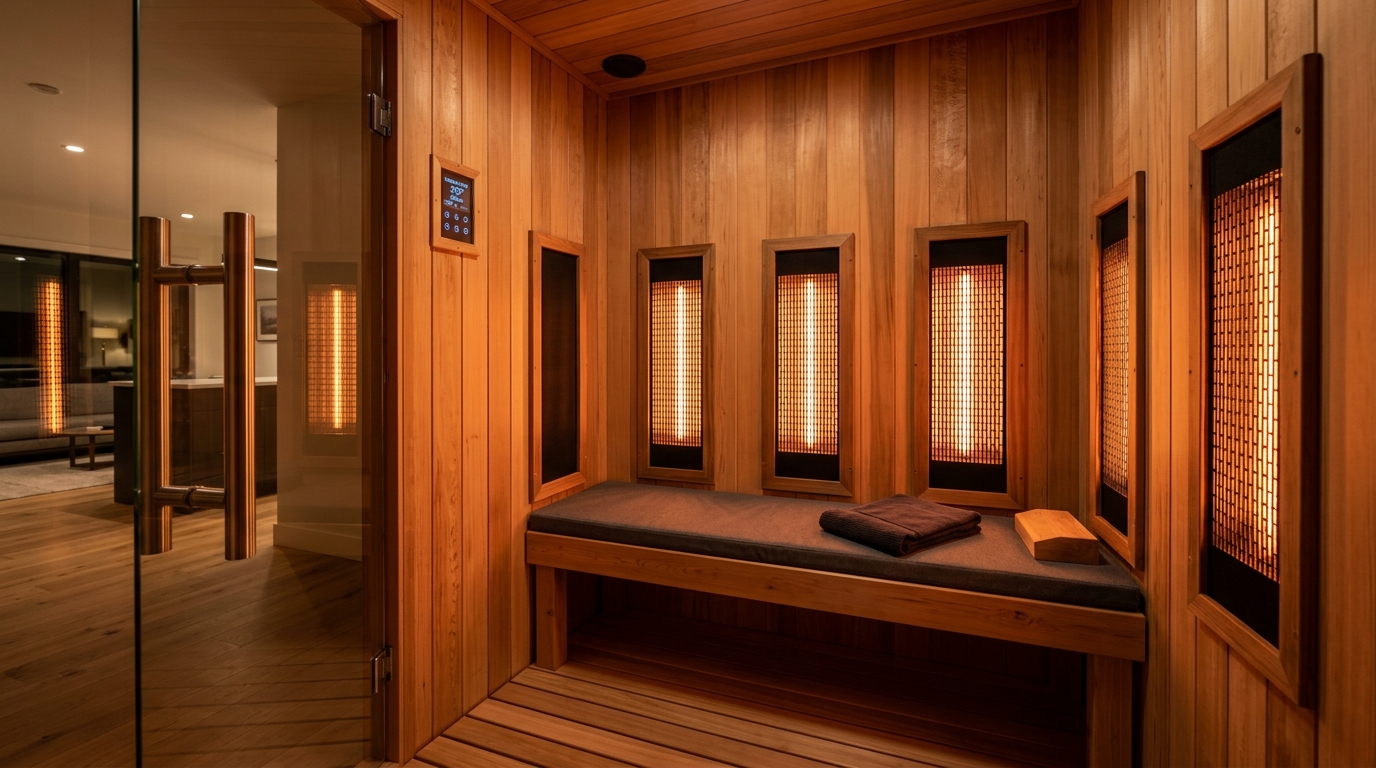
Infrared has gone from boutique-spa novelty to the dominant home-sauna format in under a decade — for one practical reason: an infrared cabin plugs into a regular wall outlet, fits in a closet, heats up in under twenty minutes, and costs less per year to run than a second refrigerator. The trade-off is that infrared is a fundamentally different experience from a traditional Finnish-style sauna. It heats your body, not the room. If you’ve used both, you already know which you prefer.
This guide is for buyers who’ve decided infrared is what they want and now need to pick between a few dozen near-identical cabinets at $1,500 to $5,000.
How infrared actually works (and what it doesn’t do)
A traditional sauna heats stones to 700°F, the stones radiate heat into the air, and the hot air heats you. An infrared sauna skips the air. Carbon or ceramic panels in the walls emit infrared wavelengths in the 5-15 micrometer range, which your body absorbs directly. Your skin warms, you sweat, the air temperature in the cabin stays around 130-145°F.
The practical implications:
- Heat-up time drops from 30+ minutes to 15-20.
- Operating temperature is lower, so the experience is closer to “a long hot bath” than “the locker room at a Finnish health club.”
- Lower-temperature operation means lower-gauge wiring works — most 2-person cabins are 110V.
- You cannot pour water on the heating elements. There is no löyly (steam burst). If that ritual matters to you, you want traditional, not infrared.
Quick comparison
| Product | Best for | Rating | Notes | |
|---|---|---|---|---|
| Single-person infrared (corner unit) | apartment, home office, smallest footprint | ★★★★☆ | ~$1,200-1,800. 12 sqft. 110V. | Check price |
| 2-person infrared cabin | daily use for one or two, indoor install | ★★★★★ | ~$2,500-4,500. 16 sqft. 110V. | Check price |
| 3-person infrared cabin | family use, more seating angles | ★★★★★ | ~$3,500-5,500. 24 sqft. Often 240V. | Check price |
| 4-person corner infrared | larger family, social use | ★★★★☆ | ~$4,500-7,500. 36 sqft. 240V. | Check price |
The picks
Best 1-person — for apartments and home offices
Best for single-occupant daily use in an apartment, home office, or finished basement corner
1-Person Corner Infrared Sauna (carbon panels, 110V)
A corner unit fits where a rectangular cabin can't. The triangular footprint claims roughly 12 square feet of floor space and uses three of your existing walls instead of needing four feet of standoff. Single-person carbon-panel units in this tier deliver the same heating performance as 2-person cabins — they're just narrower.
★★★★☆ (870 reviews)
Check current price on Amazon →Pros
- Smallest viable footprint in the category — 36 inches wide, 36 deep
- 110V plug-and-play, no electrician
- Carbon panel heaters in the back, sides, and floor
- Heat-up time around 12 minutes (less mass to warm than 2-3 person cabins)
Cons
- Genuinely a 1-person fit — adult of average height fills the seat
- Lower-mass cabin means slightly higher heat loss when you open the door mid-session
- Single-bench design means no recline option — straight upright posture only
Best overall 2-person — for daily home use
Best for couples or daily solo use; the sweet spot of the infrared cabin category
2-Person Indoor Infrared Cabin (carbon panel, low-EMF)
The 2-person infrared cabin is the genuinely useful default — large enough that you can stretch out, small enough that the heat-up time stays under 20 minutes, and inexpensive enough that the upgrade to 3-person isn't an obvious win. We bias toward units with seven or more carbon panels (back, two sides, two front corners, floor, and calf-level).
★★★★★ (1,850 reviews)
Check current price on Amazon →Best 3-person — for families and longer sessions
Best for families of three or two adults who want to lie down rather than sit upright
3-Person Infrared Cabin (240V, 8-10 carbon panels)
The step up from 2-person to 3-person is more useful than the spec difference suggests. The extra interior length lets you lie flat across the bench, which fundamentally changes the experience — most owners who upgrade from 2-person report they didn't realize how much they wanted to recline. Budget an electrician for the 240V circuit (~$300-600 install).
★★★★★ (540 reviews)
Check current price on Amazon →Best 4-person — for social use
Best for families of four or households where the sauna doubles as a social space
4-Person Corner Infrared Sauna (240V, dual-bench layout)
The 4-person corner format is the largest cabin we recommend for indoor installs — past this size, you're better served by a traditional 6-person or an outdoor barrel. Corner geometry uses a 60-inch wall and a 60-inch wall instead of demanding 96 inches of straight wall, which is the difference between fitting in a finished basement and not.
★★★★☆ (290 reviews)
Check current price on Amazon →What “low-EMF” actually means
The marketing terms “low-EMF” and “zero-EMF” are not regulated. Any manufacturer can print either on the box. The published, measured number at the bench position is what matters.
- Under 3 milligauss (mG): the genuine low-EMF target. Reputable manufacturers publish a measured value, often around 1-2 mG.
- 3-10 mG: typical for unshielded carbon panels. Not dangerous by any current health-authority standard, but higher than what “low-EMF” implies.
- Over 10 mG: common with budget tube/rod heaters. Avoid if EMF matters to you.
If a listing claims “low-EMF” without a measured number, treat that as a marketing claim, not a spec.
Carbon vs ceramic vs hybrid
Three element types dominate the category:
- Carbon panels (current best-in-class): large, flat panels in the walls. Even heat distribution, low EMF when properly shielded, longer lifespan than tube heaters.
- Ceramic tubes / rods: smaller, hotter point sources. Higher peak surface temperature, more concentrated heat (some prefer this for sweating; others find it uneven). Shorter average lifespan.
- Hybrid (carbon + ceramic): marketing-favored combination claiming the best of both. In practice, the carbon panels do most of the work; the ceramic tubes add a “spotlight” heating zone that some owners love and others bypass with a towel.
For a first infrared sauna, default to full carbon panel unless you have specific experience preferring ceramic.
Operating cost — what to actually expect
A 2-person infrared cabin draws roughly 1,800-2,400 watts during heat-up and 1,200-1,600 watts during operation. At a U.S. average electricity rate of $0.16 per kWh:
- Heat-up (20 min, 2.0 kW avg) = 0.67 kWh = $0.11
- Session (45 min, 1.4 kW avg) = 1.05 kWh = $0.17
- Total per session ≈ $0.28
Daily use over a year: roughly $100 in electricity. Less than a gym membership.
FAQ
Frequently asked questions
How long does an infrared sauna session last?
Carbon or ceramic heaters — which should I buy?
Do I need a dedicated electrical circuit?
Is infrared safe for daily use?
How does infrared compare to traditional sauna for "detox"?
How to pick yours
- Match the size to your real usage, not your aspirational usage. A 2-person cabin used daily beats a 4-person cabin used twice a week.
- Verify the heater type in the spec sheet — not the marketing copy. “Hybrid” can hide a budget tube heater behind one carbon panel.
- Confirm the wood species (cedar > hemlock > spruce > fir > basswood). The interior is what you smell every day.
- Buy from a manufacturer that sells replacement heaters as a catalog item. When the panels degrade at year 5-8, you want a $200 part swap, not a $2,000 cabinet replacement.
- For low-EMF buyers, find the measured number. If it’s not published, ask the manufacturer; if they won’t share it, that’s the answer.
Browse our full home sauna roundup for cross-category picks, or read the infrared vs traditional sauna comparison if you’re still deciding which type is right for you.