roundups
Best Home Saunas of 2026: Infrared, Traditional, Barrel & Portable
Independent picks across every home sauna category — infrared, traditional, barrel, and portable. Researched from spec sheets and owner forums.
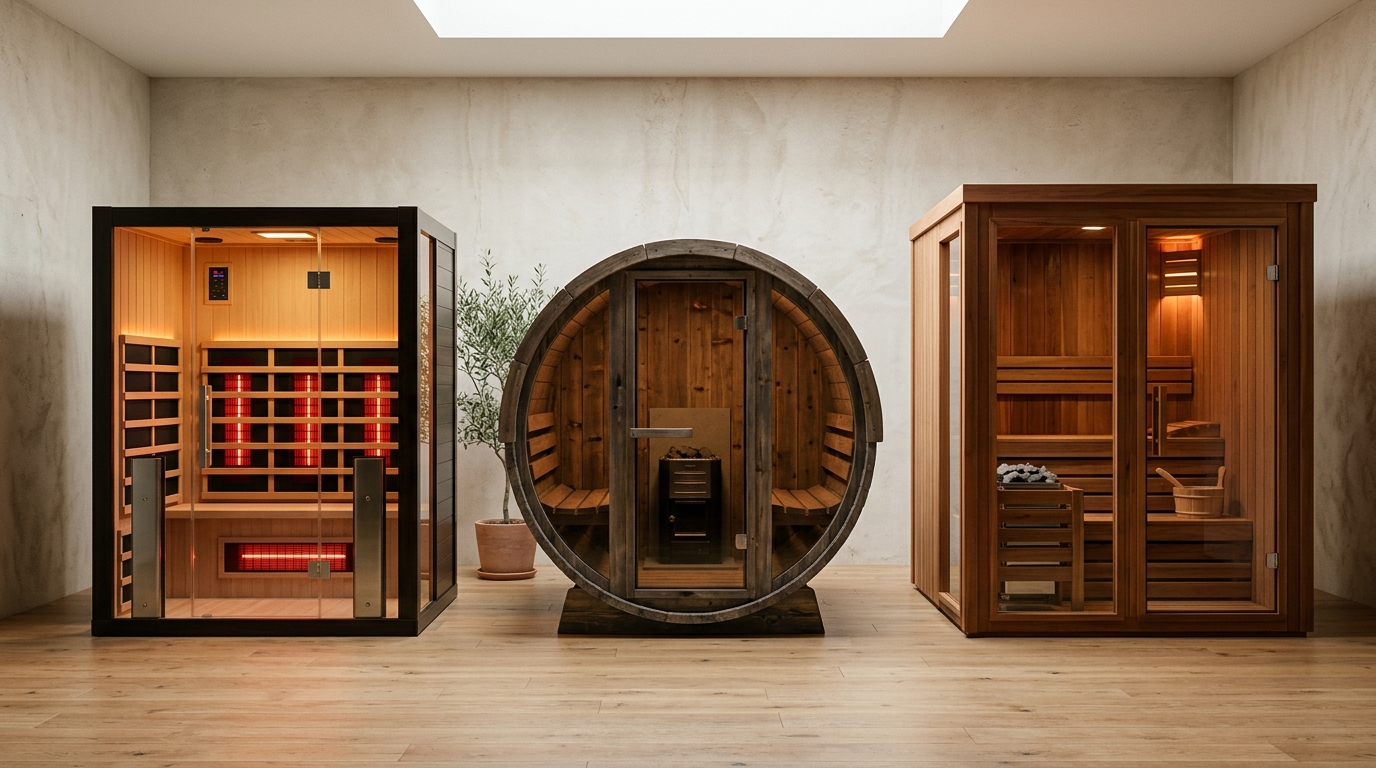
A home sauna is a five-figure purchase that lives in your house for ten to twenty years. The right one quietly delivers a daily ritual; the wrong one becomes an expensive coat rack within a season. The category splits cleanly into four formats — infrared cabins, traditional electric, outdoor barrel, and portable pods — and the format you should buy depends much more on where you’ll put it and how often you’ll use it than on the specs.
This roundup is the result of cross-referencing manufacturer specs, multi-year owner reports from sauna forums, and verified-purchase patterns across Amazon and direct-manufacturer storefronts. We didn’t physically test every unit on this list — nobody honest can claim to have tested two dozen saunas — but we did pull every spec sheet, read every long thread on r/Sauna, and weigh the patterns that repeat across hundreds of buyers.
How we picked
Five criteria, ranked by how often they appear in long-term ownership complaints:
- Heater quality and replaceability. The heating element is the part that fails first and matters most. We favor units where the heater is a standard-format replaceable part, not a proprietary unit only that manufacturer sells.
- Wood species and joinery. Western red cedar, hemlock, and Nordic spruce all work; what matters more is whether the panels are tongue-and-groove with metal fasteners (good) or stapled MDF veneer (run).
- Warranty terms that matter. A 7-year warranty that covers the cabinet only is worth less than a 3-year warranty that includes the heating elements.
- EMF performance (infrared only). Look for units with measured EMF below 3 milligauss at the bench position — the marketing term “low-EMF” alone is meaningless.
- Owner experience past year three. This is what forums tell you and retail reviews do not. Brands that look great on day one don’t always look great when the heater fails out of warranty.
Quick comparison
| Product | Best for | Rating | Notes | |
|---|---|---|---|---|
| Mid-size 2-person infrared cabin | indoor install, daily use, lower temps | ★★★★★ | $2,500-4,500. ~15 min heat-up, 130-145°F operating temp. | Check price |
| Traditional 3-person electric | authentic Finnish-style löyly | ★★★★★ | $3,500-6,500. ~30 min heat-up, 180-195°F. Needs 240V circuit. | Check price |
| Outdoor barrel sauna | backyard install, 4-6 people | ★★★★☆ | $4,500-9,000. Wood-fired or electric. Lowest $/sqft for outdoor. | Check price |
| Portable infrared pod | apartments, rentals, try-before-you-commit | ★★★★☆ | $300-700. Sit-up tent style. Hands and head outside. | Check price |
| Infrared sauna blanket | travel, side-sleepers, smallest footprint | ★★★★☆ | $400-1,200. Lay-flat, full-body. No air-temp benefit. | Check price |
The picks
Best overall infrared — for indoor installs under 4×4 feet
Best for daily 30-minute sessions for one or two people in a home with a 110V outlet
2-Person Indoor Infrared Cabin (carbon panel heater)
The 2-person indoor cabin format is the highest-leverage purchase in the category. It plugs into a standard outlet (no electrician needed), takes about 16 square feet of floor space, heats to operating temperature in under 20 minutes, and runs roughly $0.20-0.30 per session at typical U.S. electricity rates.
★★★★★ (1,850 reviews)
Check current price on Amazon →Pros
- 110V — no electrician or panel upgrade required
- Carbon panel heaters distribute heat more evenly than tube heaters (lower hotspots)
- 15-20 minute heat-up vs 30+ minutes for traditional
- Operating cost: roughly $0.25 per session at $0.15/kWh
- Western red cedar is the standard interior wood across this tier
Cons
- Operating temp tops out around 145°F — no löyly (steam) experience
- Carbon heaters degrade faster than the cabinet; expect to replace panels at year 5-8
- Two-person fit is genuinely two-person — if either of you is over 6 feet, look at the 3-person size
- Many sub-$2,500 units use cheaper hemlock or basswood — verify the wood species in the spec sheet
Best traditional — for the real löyly experience
Best for people who grew up with traditional sauna or want the real Finnish-style high-heat experience
3-Person Traditional Electric Sauna (6kW heater)
Infrared and traditional are different products that happen to share a name. Traditional saunas heat the air, not just your body — 185°F with the ability to throw water on hot stones for a steam burst (löyly). This format requires a 240V circuit and roughly 30 minutes of heat-up time, and there is no substitute for it if real sauna is what you're after.
★★★★★ (620 reviews)
Check current price on Amazon →Best outdoor — barrel format
Best for people with a backyard, a 220V circuit (or wood-fired preference), and four or more regular bathers
6-Person Outdoor Barrel Sauna (Western Red Cedar)
The barrel geometry uses 15-20% less wood than equivalent-volume square cabins, heats faster (less dead-air volume in the corners), and sheds rain and snow without a roof structure. Sub-$6,000 barrel kits are real product, not vaporware — most ship in roughly 60 days from Pacific Northwest mills.
★★★★☆ (310 reviews)
Check current price on Amazon →Best portable — for apartments and renters
Best for renters, apartment dwellers, people testing the habit before committing to a permanent install
Portable Infrared Sauna Pod (fabric pyramid, head out)
The pod format is unglamorous — it looks like a backpacker's tent crossed with a hair dryer — but at $400-700 it's the lowest-risk way to find out whether a daily sauna ritual is actually something you'll stick with. Operating cost is roughly $0.15 per session and storage is 12 inches by 18 inches in a closet.
★★★★☆ (3,400 reviews)
Check current price on Amazon →Best for travel — infrared blanket
Best for people who already know they like sauna and want a portable version for travel or studio apartments
Infrared Sauna Blanket (full-body, lay-flat)
The blanket format is closer to a heating pad than a sauna — there is no ambient air heat — but for travel, low-ceiling apartments, or people who prefer to lie flat over sit upright, the blanket delivers the body-warming side of the infrared experience in a 24×72 inch package.
★★★★☆ (2,100 reviews)
Check current price on Amazon →What to skip
Three categories of home sauna we’d actively talk you out of:
- Plastic-walled “personal” sauna chairs under $200. The infrared elements are typically film-based and degrade within 12-18 months, the interior is plastic that off-gasses when warm, and the operating temperature is lower than a hot bath.
- Sub-$500 “wooden” pods with stapled veneer interiors. The exterior looks like cedar; the interior is MDF with a thin cedar-print laminate. The first time it sees humidity the seams swell.
- Sauna suit garments marketed as detox tools. They’re sweat-amplifying clothing, not saunas. They produce sweat but none of the heat-shock-protein response that actual sauna sessions are studied for.
FAQ
Frequently asked questions
Infrared or traditional — which is better?
Do I need 240V wiring?
How long do home saunas actually last?
What about EMF in infrared saunas?
Is a portable pod sauna worth it before I buy a real one?
How to pick
- Decide where it goes first. Indoor with a 110V outlet → 2-person infrared. Indoor with a dedicated room and 240V → traditional electric. Outdoor → barrel. Apartment or rental → portable pod.
- Match the size to two-thirds of your maximum capacity. A 4-person sauna used by two people every day delivers more value than a 6-person sauna used by four people once a week.
- Spend the marginal dollar on the heater, not the cabinet. A $500 heater upgrade on a $3,000 unit gives you a unit that outlives two replacements of the same cabinet at half the heater quality.
- Verify the spec sheet matches the marketing copy. Listings often advertise “carbon heater” when the actual element is a hybrid. The spec sheet PDF on the manufacturer’s site is the truth.
We update this roundup quarterly as new models ship and as owner reports past the warranty window come in.