guides
How Much Does a Home Sauna Cost? (Full Breakdown for 2026)
Real cost ranges for every home sauna type — infrared, traditional, barrel, portable — plus install, electrical, and 10-year ownership totals.
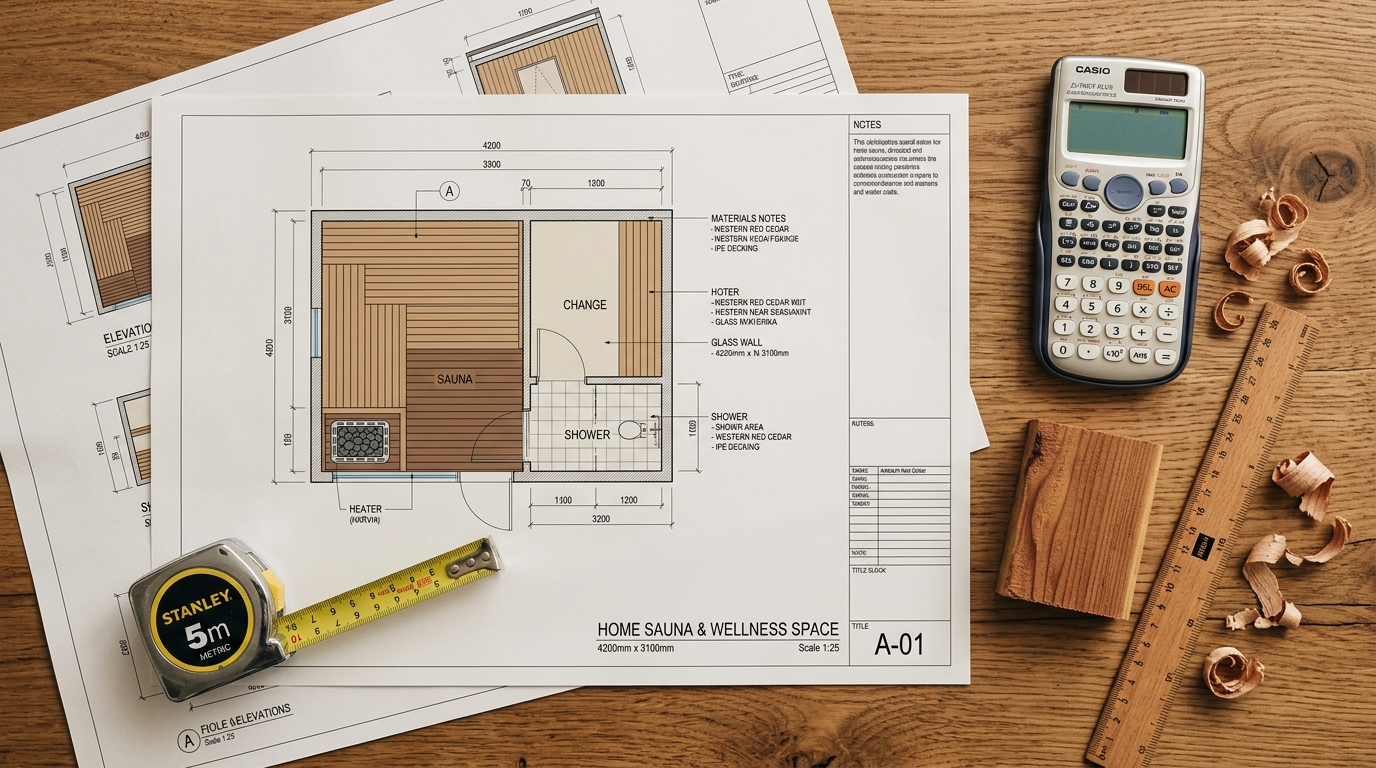
The most common mistake people make budgeting a home sauna is comparing the cabin price tag and stopping there. The cabin is the visible cost. The total cost of ownership is the cabin plus install, plus operating costs over a decade, plus one heater replacement somewhere in years 5-8. Here’s the actual math for every format, including the line items the marketing pages skip.
Cabin cost by format
| Product | Best for | Rating | Notes | |
|---|---|---|---|---|
| Portable pod tent | lowest entry tier | — | $300-700. No install. Lifespan 2-4 years. | — |
| Infrared sauna blanket | travel / lay-flat | — | $400-1,200. No install. Lifespan 3-5 years. | — |
| 1-person corner infrared | smallest fixed cabin | — | $1,200-1,800. 110V. Lifespan 8-12 years. | — |
| 2-person infrared cabin | best-value daily-use sweet spot | — | $2,500-4,500. 110V. Lifespan 10-15 years. | — |
| 3-person infrared cabin | family or 2 adults wanting recline space | — | $3,500-5,500. Often 240V. Lifespan 10-15 years. | — |
| 4-person infrared corner | social use, larger family | — | $4,500-7,500. 240V. Lifespan 12-15 years. | — |
| 2-person traditional electric | real löyly in tighter spaces | — | $2,800-4,500. 240V. Lifespan 15-20 years. | — |
| 3-person traditional electric | best balance for serious traditional users | — | $3,500-6,500. 240V. Lifespan 15-20 years. | — |
| 6-person traditional electric | large families, social use | — | $5,500-9,500. 240V. Lifespan 15-25 years. | — |
| Outdoor barrel sauna | backyard install, premium experience | — | $4,500-9,000. Wood-fired or electric. 20+ years. | — |
| Custom-built indoor sauna | high-end remodels | — | $10,000-30,000+. Bespoke install. | — |
The hidden line items
Electrical install
This is the biggest cost surprise for first-time buyers.
- 110V cabin (most 1- and 2-person infrared): $0 — plug it in. We still recommend a dedicated circuit so a microwave or hairdryer doesn’t trip the breaker mid-session; if you need that breaker installed, budget $150-300.
- 240V cabin (most 3+ person infrared, all traditional electric): $400-1,200 for a licensed electrician to install a dedicated 240V/30-40A circuit. Higher end of the range if the panel is more than 30 feet from the cabin location or if your panel is full and needs a sub-panel.
- Wood-fired (outdoor barrel only): $0 electrical, but budget $200-500 for stovepipe materials and a spark arrestor if your local code requires one.
Site prep
- Indoor on existing floor: $0.
- Indoor on slab basement with floor drain: $0-200 (silicone caulk, maybe a non-slip mat).
- Outdoor on existing patio/deck: $0-300 (level check, possibly some additional support).
- Outdoor needing a pad: $400-1,500 (4-6 inch concrete pad poured to a 6×8 or 8×8 footprint).
Permits
Permits are rarely required for plug-in infrared cabins. Traditional saunas with 240V hardwired installations sometimes require an electrical permit ($50-200). Outdoor structures over a certain footprint (varies by jurisdiction, often 100 sqft) require a building permit ($100-500). Check your municipality before you commit.
Delivery
- Indoor sauna delivered curbside: included on most $2,500+ cabins. White-glove (in-home delivery to room): add $200-400.
- Outdoor barrel delivered curbside: $200-600 (these ship by freight; expect a 12-foot pallet).
- Some 4-person and larger cabins arrive in multiple boxes — verify before delivery day that you have the staging space.
Assembly
Most infrared cabins are designed for two-person assembly in 60-90 minutes — they’re effectively a wood-paneled flat-pack with electrical connections. Traditional saunas with separate heaters add 1-2 hours of work for stone placement and heater mounting. Outdoor barrels typically take 4-8 hours for two people, or $400-800 for a hired installer.
10-year total cost of ownership
The cabin price is the start, not the total. Here’s what a decade of ownership actually looks like:
2-person infrared cabin example
- Cabin: $3,200 (mid-range pick)
- Install electrical: $0
- Operating cost (daily use, $0.28/session): $1,020/year × 10 = $10,200
Wait, that operating-cost number is alarming on first read. Let me make it less so. Daily use is the upper bound — most owners settle into 3-5 sessions per week. At 4 sessions/week:
- Operating: $0.28 × 4 × 52 × 10 = $582 over 10 years
Plus:
- Heater panel replacement at year 6-8: $250-450
- Light bulb / control board replacement: $50-150
10-year total: roughly $4,100-4,200 for the cabin + electricity + one consumables refresh.
3-person traditional electric example
- Cabin: $5,000
- Electrical install: $700
- Operating (4 sessions/week, $0.95/session): $1,975 over 10 years
- Stones replacement at year 5 (igneous rocks degrade in heat cycling): $120-200
- Heater element replacement at year 8-10: $400-650
10-year total: roughly $8,200-8,500.
Outdoor barrel sauna example
- Barrel kit: $6,500
- Pad install (DIY or contractor): $0-1,200
- Operating (3 sessions/week, $0.95/session for electric heater): $1,480 over 10 years
- Cedar maintenance (oil + stain every 3 years): $120-200 total
- Heater element replacement at year 8: $400-650
- Door seal replacement: $60-100
10-year total: roughly $8,600-10,200.
How to allocate your budget
If your total budget is under $1,000: portable pod or blanket. Treat it as a test of whether the habit sticks. Don’t overspend at this tier.
If your total budget is $2,500-5,000: 2-person infrared cabin is the sweet spot. Spend the marginal dollars on the heater quality (carbon panels over tube heaters, published EMF measurement, replaceable panels). The cabinet differences matter less.
If your total budget is $4,000-8,000: you have real options. Traditional 2-3 person electric if you want löyly. 3-4 person infrared corner if you want indoor and don’t need the high-heat experience. Look at warranty terms — three-year heater coverage beats five-year cabinet-only.
If your total budget is $8,000-15,000: outdoor barrel or premium indoor traditional. At this tier you should be reading owner forums for specific brands rather than category-level guides.
If your total budget is $15,000+: custom-built or premium European brand (Finnleo, Tylo, Helo are the names that recur in installer interviews). At this tier the cabin price is the smaller part of the equation; install and ongoing service contracts matter more.
Picks at each tier
Under $1,000
Best for testing the habit, apartments, lowest-risk entry
Portable Infrared Sauna Pod
The portable pod is the rational entry tier. $400-700 puts you into a working infrared session you can run nightly in a closet or bedroom corner, with no electrician and no commitment. After 60 days of consistent use, you have your answer — and the upgrade path to a $3,000 cabin is straightforward.
★★★★☆ (3,400 reviews)
Check current price on Amazon →$2,500-4,500 (the value tier)
Best for the highest-leverage product in the category
2-Person Indoor Infrared Cabin
A mid-range 2-person infrared cabin is what most home buyers actually want even when they think they want something fancier. Plug-and-play 110V, fits in a 16-square-foot footprint, heats in under 20 minutes, runs at roughly $0.25 per session. Heater longevity in this tier is 5-8 years before any panel replacement is needed.
★★★★★ (1,850 reviews)
Check current price on Amazon →$4,500-8,000 (traditional + outdoor tier)
Best for real löyly experience, dedicated indoor sauna room
3-Person Traditional Electric Sauna
A 3-person traditional electric with a 6 kW heater is the right size for serious traditional sauna use at home. Big enough that one adult can lie flat across the bench; small enough that the 30-minute heat-up doesn't feel punishing. Plan an electrician visit for the 240V circuit before delivery — running cable is cheaper before the cabin is in the room.
★★★★★ (620 reviews)
Check current price on Amazon →FAQ
Frequently asked questions
Why are some sauna kits so much cheaper on Amazon than direct-to-consumer brands?
How much does it cost to run a home sauna per session?
What ongoing maintenance does a home sauna need?
Is a home sauna a good investment? Does it add resale value?
Are there any tax credits or rebates for home saunas?
Bottom line
Realistic all-in budgets:
- Testing the habit: $400-700 portable
- Value-tier daily use: $2,500-4,500 (infrared, no install)
- Real Finnish-style: $4,000-7,700 (traditional + electrician)
- Outdoor backyard: $5,000-10,500 (barrel + pad)
- Custom luxury: $15,000+
Pick the tier that matches your actual use frequency, not your aspirational one. A $3,000 cabin used five times a week beats a $7,000 cabin used twice a month — both in cost-per-session and in the only outcome that matters, which is whether the daily ritual sticks.
Browse the best home saunas roundup for cross-category picks, or read the infrared vs traditional comparison if you’re choosing between formats.