comparisons
Cold Plunge Pool vs Tub: Which Should You Buy?
Cold plunge pool vs cold plunge tub compared on size, cost, chiller requirements, and space so you can pick the right cold therapy setup.
 Marcus Reade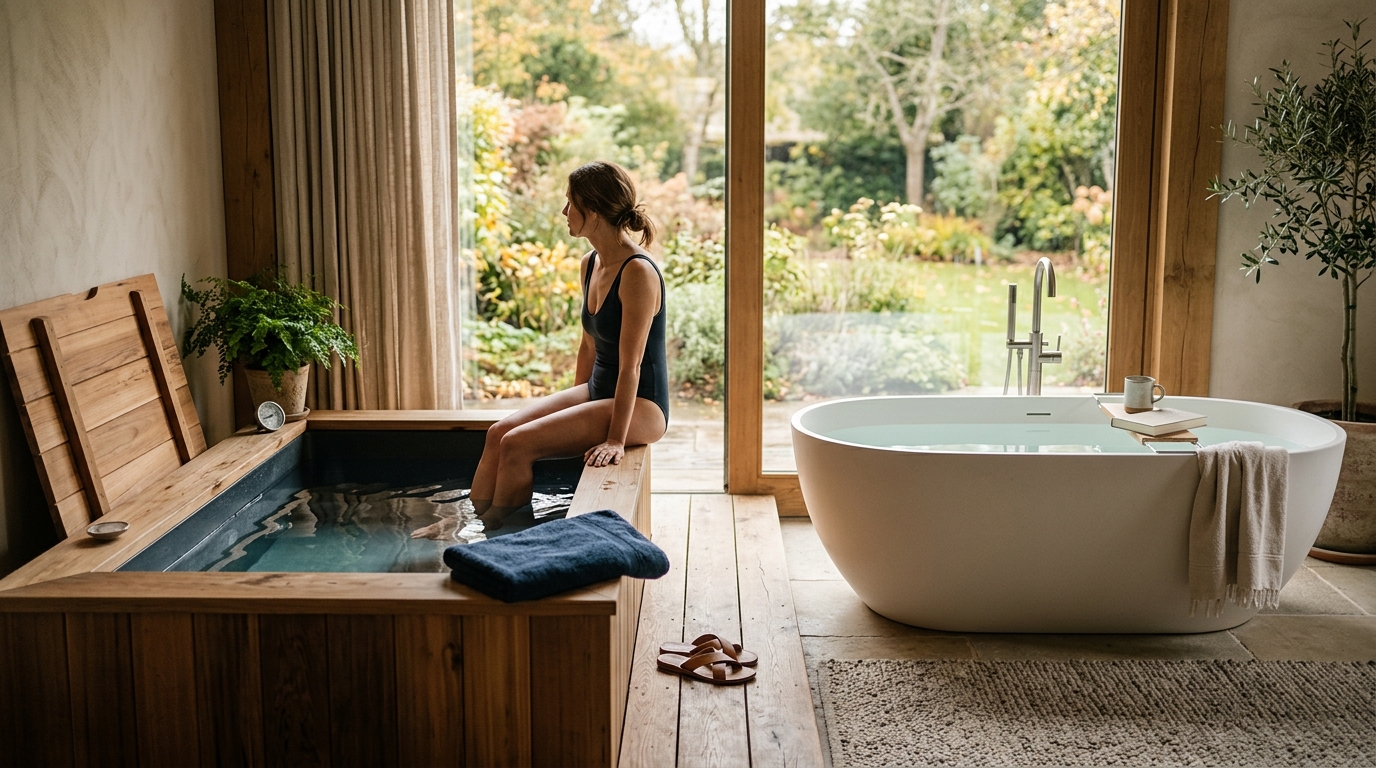
Quick answer: A cold plunge tub (80–150 gallons, compact footprint) is the right choice for most home users — it costs $500–5,000, fits in a bathroom or garage corner, and a modest chiller keeps it at temperature effortlessly. A cold plunge pool (200–600 gallons, pool-like dimensions) makes sense if you want to submerge fully with legs extended, share with a partner regularly, or prefer a permanent outdoor installation. Expect to pay $3,000–20,000+ for a pool setup and a significantly more powerful chiller.
What is the difference between a cold plunge pool and a cold plunge tub?
A cold plunge tub is a compact, purpose-built vessel — typically barrel-shaped, cylindrical, or rectangular — designed for one person sitting upright or semi-reclined. Volume runs 80 to 150 gallons. These are the units most people picture when they search for a home cold plunge: Ice Barrel, The Plunge, Polar Recovery tubs, and similar products. An entry-level portable chiller couples to the vessel and holds your target temperature continuously. Footprint is roughly equivalent to a large trash can or small chest freezer — it fits in a bathroom, a corner of a home gym, or on a covered deck.
A cold plunge pool is a larger vessel — usually rectangular and designed for full-body horizontal or semi-reclined immersion with legs extended — holding 200 to 600 or more gallons. Some are freestanding acrylic or fiberglass units marketed explicitly as cold plunge pools. Others are small plunge pools purchased from hot tub retailers and configured for cold use with a dedicated chilling unit. A few homeowners use a small above-ground swimming pool with a pool chiller. Volume makes these categorically different from tubs: you need a more powerful chiller, more water treatment, more space, and a larger initial investment.
The therapeutic outcome of cold water immersion is determined almost entirely by water temperature and immersion duration — not by vessel size or body position. The well-established target range is 50–59°F (10–15°C) for 2–5 minutes per session. A 100-gallon tub and a 400-gallon pool held at 55°F produce the same physiological response: vasoconstriction, the norepinephrine and dopamine surge, and reduced systemic inflammation. Size is a comfort, convenience, and logistics question, not a therapeutic one.
Cold plunge pool vs tub: direct comparison
| Product | Best for | Rating | Notes | |
|---|---|---|---|---|
| Water volume | Tub: 80-150 gallons. Pool: 200-600+ gallons. | — | Volume drives chiller size, cost, cool-down time, and water treatment requirements more than any other variable. | — |
| Upfront cost | Tub: $500-5,000 all-in with chiller. Pool: $3,000-20,000+ including compatible chiller. | — | Most entry-level home users get a complete functional tub-plus-chiller setup for $800-1,500. | — |
| Chiller requirement | Tub: 1/2 to 1 HP residential chiller. Pool: 1.5-5 HP commercial-grade chiller. | — | Undersizing a chiller on a large pool leads to temperature creep — the vessel warms faster than the chiller recovers it. | — |
| Footprint | Tub: 2-4 sq ft. Pool: 15-60+ sq ft plus chiller space. | — | A compact barrel tub sits in a bathroom corner or on a 3 x 3 ft deck area. A plunge pool typically needs a dedicated room section or permanent outdoor pad. | — |
| Cool-down time | Tub: 2-4 hours from room temperature. Pool: 6-24 hours from room temperature. | — | Larger volume means longer initial cool-down. Between daily sessions a pool may not fully recover if the chiller is undersized. | — |
| Immersion position | Tub: seated or semi-reclined, legs bent. Pool: full horizontal immersion with legs extended. | — | Most users adapt quickly to seated immersion. Full horizontal submersion is more comfortable for taller people or longer sessions. | — |
| Multi-user capacity | Tub: 1 person at a time. Pool: 1-4 people depending on size. | — | A couple doing simultaneous contrast therapy benefits significantly from a pool-sized vessel. | — |
| Water maintenance | Both require sanitizer; pools need proportionally more chemical management for larger volume. | — | A 400-gallon pool with heavy use needs testing 2-3x per week. A 100-gallon tub with a good filter is more forgiving. | — |
| Installation | Tub: plug-and-play, GFCI outlet. Pool: may need electrical upgrade, drainage, and structural pad. | — | Larger chillers often require a 240V dedicated circuit. Budget $300-800 for an electrician if upgrading from a standard 120V outlet. | — |
| Noise | Tub chiller: 45-55 dB (comparable to an air conditioner). Pool chiller: 55-70 dB (comparable to a commercial HVAC unit). | — | Pool-grade chillers are significantly louder. Outdoor placement is often necessary to keep noise tolerable. | — |
| Resale / portability | Tub: easily moved or sold. Pool: largely permanent once installed. | — | A tub-and-chiller setup has strong resale value. A custom plunge pool installation is effectively a home improvement. | — |
When a cold plunge pool is the better choice
Choose a cold plunge pool when:
- You are 6 feet tall or taller and find upright immersion uncomfortable. Taller users frequently find that barrel or cylindrical tubs require an awkward bent-knee position that reduces immersion depth and comfort. Full-length horizontal immersion in a pool-style vessel is markedly more comfortable for regular use.
- Multiple household members plunge simultaneously. A couple doing daily morning contrast therapy, or a household of athletes all running the same recovery protocol, gets real value from a vessel large enough for two people. Shared vessels also dilute the per-person chiller and infrastructure cost.
- You have the outdoor space and want a permanent installation. A cold plunge pool installed on a backyard pad alongside a barrel sauna or outdoor sauna cabin creates a dedicated recovery zone that is meaningfully different from a gym-corner tub. The aesthetic and the experience justify the cost for many users once that space is available.
- You want full-body horizontal immersion for swimming-style recovery protocols. Some rehabilitation and sports medicine protocols involve more dynamic movement — gentle kicking, arm movement — that requires the clearance a pool provides.
- You are already committed to cold therapy and plunge daily. If you have practiced for six months or more, plunge every day, and have the budget and space, a pool-grade setup is a reasonable long-term investment. At that frequency and commitment level, the comfort and capacity advantages matter.
The honest case for pools: the experience of lying fully horizontal in cold water at 50°F is categorically more immersive than sitting upright with knees bent. For some users, that experience drives greater consistency and deeper sessions. If the vessel makes you want to use it every day, it is the right vessel.
When a cold plunge tub is the better choice
Choose a cold plunge tub when:
- You are a solo user doing 1–3 sessions per week. The therapeutic protocols do not require horizontal immersion or pool-scale volume. A compact tub with a chiller set to 55°F delivers the full physiological benefit. There is no scenario where you get more norepinephrine from a bigger vessel.
- Space is limited. Most homes and apartments can accommodate a barrel tub or compact rectangular tub. A plunge pool cannot. If your recovery area is a bathroom corner, a spare bedroom, or a section of a garage, a tub is the only practical option.
- Budget is under $3,000. Complete tub-and-chiller setups start around $800–1,500. Functional pool setups rarely come in under $3,000, and purpose-built cold plunge pool units typically start at $5,000–8,000 before factoring in a commercial chiller and electrical work.
- You want portability or flexibility. Tubs move. If you rent, plan to relocate, or want the option to sell the unit later, a portable tub and chiller retains its value and its mobility. A plunge pool does not.
- You are new to cold therapy. Start with a tub and validate the practice before committing to pool-scale infrastructure. Every experienced cold therapy practitioner recommends building a consistent routine before investing heavily in equipment.
For most residential users — solo practitioners, couples where one person plunges, anyone working within a normal budget and a normal home — a cold plunge tub delivers every meaningful benefit of cold water immersion at a fraction of the cost and complexity of a pool.
Chiller requirements: the most important technical difference
The volume difference between a tub and a pool is not cosmetic — it directly determines what chiller you need, which cascades into electrical, cost, and noise implications.
For cold plunge tubs (80–150 gallons): A residential chiller rated at 1/2 to 1 HP (approximately 5,000–8,000 BTU/hour) handles the cooling load reliably. These units plug into a standard 120V outlet (or sometimes 240V for the stronger models), are roughly microwave-sized, and operate at a noise level comparable to a window air conditioner. Cost for a quality unit: $300–800.
For cold plunge pools (200–600 gallons): You need a chiller rated at 1.5 to 5 HP — commercial-grade pool chilling equipment. These units require a 240V dedicated circuit in most cases, produce significantly more noise (55–70 dB), and cost $1,500–5,000+ for the chiller alone, not including the pool vessel. Undersizing the chiller — a common and expensive mistake — means the pool cannot recover temperature between sessions, defeating the purpose of automatic temperature control.
A practical rule: multiply your vessel volume by 50 BTU/hour as a minimum chiller sizing baseline. A 100-gallon tub needs at least 5,000 BTU/hour. A 400-gallon pool needs at least 20,000 BTU/hour. Always round up, not down, when choosing chiller capacity.
Product picks
Best compact cold plunge tub for most users
Best for solo users wanting a low-footprint tub with efficient upright immersion
Ice Barrel 400 Cold Plunge Tub
The vertical barrel design holds around 105 gallons, minimizing the water volume a chiller must maintain while still submerging your torso and shoulders completely. The upright seated position is ergonomically comfortable for most users under 6 feet 4 inches tall. The small footprint — roughly equivalent to a large trash can — works in bathrooms, corners of home gyms, and covered decks. Pair with a compatible portable chiller and the full setup comes in under $1,200.
★★★★★ 4.5 · 2,300 reviews
Check current price on Amazon→Best entry-level chiller for tub setups
Best for tub owners who want reliable temperature control down to 40 degrees Fahrenheit
Penguin Chillers Cold Plunge Water Chiller
Penguin Chillers makes some of the most well-regarded residential cold plunge chillers on the market. The 1/3 HP and 1/2 HP units handle 80–120 gallon tubs on a standard 120V outlet. Titanium heat exchanger, precise digital temperature control, and a filtration loop keep water clean between sessions. Quieter than most competitors in this class. The go-to recommendation for new tub buyers who want proven reliability.
★★★★★ 4.6 · 1,180 reviews
Check current price on Amazon→Best pool-style cold plunge for serious home setups
Best for taller users or couples who want horizontal immersion and a premium permanent installation
Renu Therapy Nordic Cold Plunge Pool System
Renu Therapy builds pool-style cold plunge systems designed for full-body horizontal immersion. The acrylic vessel holds 250+ gallons with enough length for users up to 6 feet 5 inches to extend fully. Built-in filtration, UV sanitation, and a powerful integrated chiller handle the volume reliably. The price is substantial — expect $8,000–15,000 installed — but for a dedicated two-person household with an outdoor recovery space, it is the right call.
★★★★☆ 4.4 · 340 reviews
Check current price on Amazon→Installation and space planning
Cold plunge tub: Place on a level surface capable of supporting 800–1,400 lbs when filled. Indoors, most floors handle this without reinforcement. Outdoors, a concrete pad or solid wood deck works. Route a GFCI-protected 120V (or 240V for stronger chillers) outlet within 6 feet. Plan for a drain nearby — either a floor drain, a hose routed to a drain, or the option to pump water out during water changes. Most tub-plus-chiller setups are running within 2–3 hours of arrival with no professional installation required.
Cold plunge pool: A pool holding 400 gallons weighs approximately 3,400 lbs when filled. This is beyond what most residential interior floors can support without structural assessment, making outdoor installation the practical choice for most pool setups. You will need a level concrete pad, proper drainage, and almost certainly a 240V dedicated circuit for the chiller. Budget $500–2,000 for site preparation, electrical upgrade, and plumbing if your space requires it. Factor this into your total cost comparison with a tub.
Both setups: Position wherever you will actually use the setup consistently. The most technically impressive cold plunge pool in an inconvenient corner of the yard will produce worse outcomes than a modest tub in your bathroom. Proximity to your post-workout space and ease of access are underrated factors in long-term adherence.
FAQ
Frequently asked questions
Is a cold plunge pool more effective than a cold plunge tub?
What size chiller do I need for a cold plunge pool?
Can I use an above-ground swimming pool as a cold plunge pool?
How long does it take a chiller to cool a cold plunge pool vs a tub?
Which is easier to maintain — a cold plunge pool or a tub?
Do I need a permit to install a cold plunge pool?
Bottom line
For the vast majority of home users, a cold plunge tub with a residential chiller is the right choice. It delivers every meaningful physiological benefit of cold water immersion at a fraction of the cost, complexity, and space requirement of a pool-style setup. Start with a high-quality 100–120 gallon tub and a properly sized chiller, establish a consistent routine, and you will have everything you need.
A cold plunge pool makes sense in specific situations: you are consistently tall enough to find seated immersion uncomfortable, you share the setup daily with a partner, you have dedicated outdoor space and the budget for a permanent installation, and you already know you will use it every day. In those circumstances, the larger investment in a pool-style setup is justified.
For top-rated cold plunge tubs and chillers at every price point, see our best cold plunge roundup and our best cold plunge chillers guide. If you are building a complete sauna-and-cold-plunge recovery setup, our contrast therapy guide covers the protocol and sequencing. For cold plunge maintenance, read our cold plunge maintenance guide before you fill for the first time.