roundups
Best 3-Person Home Saunas (Indoor & Outdoor, 2026)
Expert picks for 3-person saunas across infrared, indoor traditional, and outdoor barrel. Real specs, honest trade-offs, and operating costs.
 Marcus Reade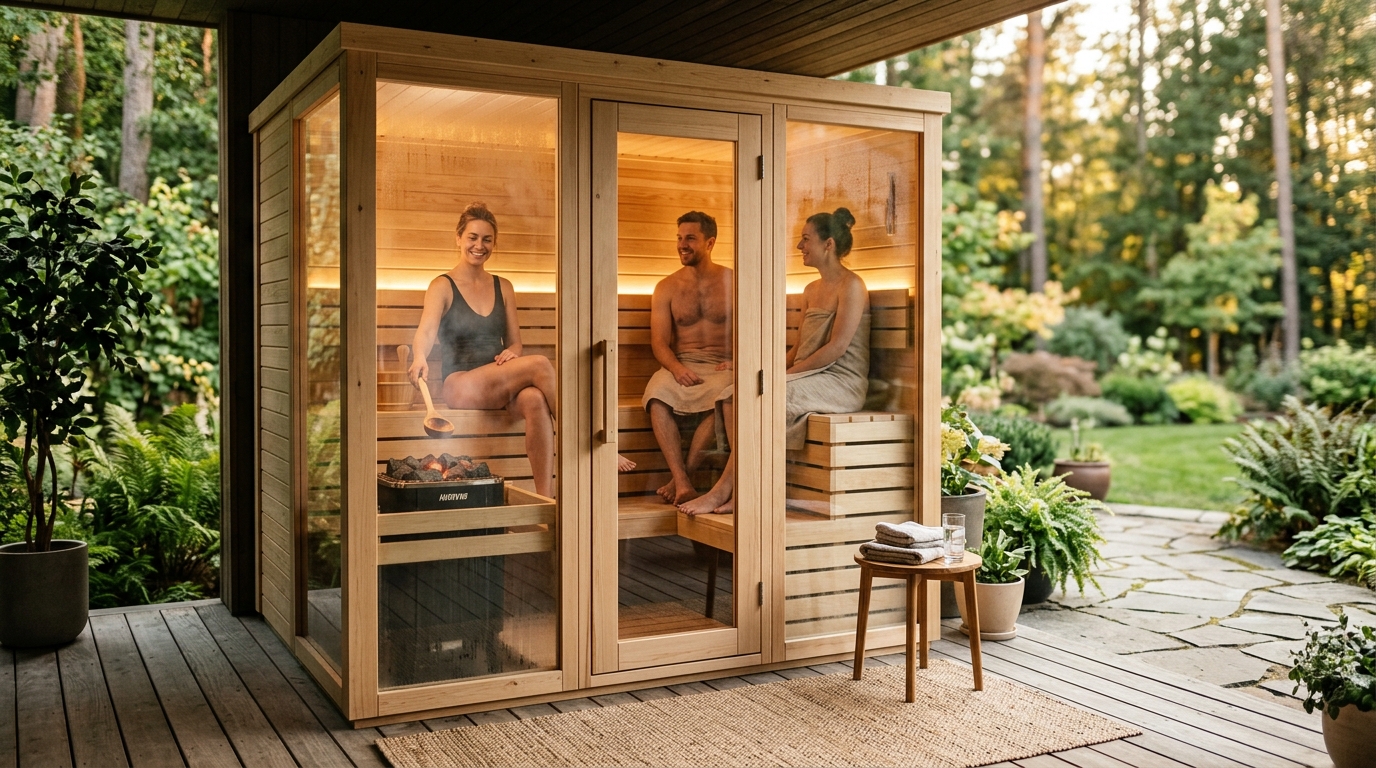
The best 3-person sauna for most buyers is a 3-person carbon-panel infrared cabin (110V plug-in, 22–24 sq ft, cedar or hemlock interior). The best outdoor pick is a 3-person cedar barrel sauna with an electric heater — it heats faster than a cube, lasts longer, and gives you the full traditional experience without an indoor build-out.
The 3-person format is the first size category where the decision genuinely changes based on how you plan to use the space. With two people, almost any layout works. With three, you need to think about bench geometry, interior length, and whether all three occupants can sit comfortably at the same time — not just technically fit. This guide walks through the three main formats, picks the best option in each, and tells you exactly what to look for in the specs so you don’t overpay for a cabin that is really built for two.
Format choice — pick this first
Three sub-categories, three different experiences. You are not picking a brand yet — you are picking the format that fits your space, electrical situation, and how you actually want to use the sauna.
- Infrared (indoor) — Heats the body directly at 130-150°F. Most 3-person models run on a standard 110V outlet (verify amperage). Heat-up time 15-25 minutes. Operating cost roughly $0.25-0.40 per 45-minute session. No steam option (löyly). Best for daily use with minimal installation friction.
- Traditional indoor (electric heater) — Heats the air to 170-200°F. Requires a 240V circuit and a licensed electrician in most jurisdictions. Heat-up time 35-50 minutes. Produces real steam from the löyly ritual (pouring water on hot rocks). Best for buyers who want the authentic Finnish sauna experience inside the home.
- Outdoor barrel (electric or wood-fired) — The cylindrical form retains heat efficiently, drains rain and snow naturally, and looks genuinely handsome as a backyard fixture. Electric barrels need a 240V outdoor outlet. Wood-fired barrels need no electrical install but require active fire management. Best for buyers with outdoor space and an appetite for the traditional ritual.
If you are on the fence, default to infrared. It installs in under two hours, uses a standard outlet, and gets daily use because the friction to start a session is almost zero.
Quick comparison
| Product | Best for | Rating | Notes | |
|---|---|---|---|---|
| 3-person carbon-panel infrared (110V, cedar) | best overall for daily indoor use | ★★★★★ | ~$3,000-5,500. 22-24 sqft. Plug-and-play. | Check price |
| 3-person full-spectrum infrared (NIR + MIR + FIR) | near infrared LED panels plus far infrared heat | ★★★★★ | ~$4,500-7,000. 22-24 sqft. Some need 240V. | Check price |
| 3-person indoor traditional (240V electric heater) | Finnish-style indoor sauna with löyly steam | ★★★★☆ | ~$4,500-7,500. 240V circuit required. 6-8 kW heater. | Check price |
| 3-person outdoor barrel sauna (electric heater) | best traditional outdoor experience for three | ★★★★★ | ~$5,500-9,000. 240V. 6-7 ft cedar barrel. | Check price |
| 3-person outdoor barrel sauna (wood-fired) | off-grid; no outdoor electrical outlet required | ★★★★★ | ~$6,500-10,000. No wiring. Chimney stack required. | Check price |
The picks
Best overall — 3-person carbon-panel infrared (indoor)
Best for daily indoor use; families and small groups who want a session available in 20 minutes
3-Person Carbon-Panel Infrared Sauna (110V, low-EMF, cedar or hemlock)
A genuine 3-person infrared cabin has a minimum interior width of 72 inches, nine or more carbon far-infrared panels covering the back wall, both side walls, the floor, and the calf-level position, and a measured EMF at the bench under 3 milligauss. At the 3-person scale, bench geometry matters more than it does at the 2-person scale — the better cabins have a full-length main bench (72 inches) plus a side or L-bench so all three occupants can sit comfortably without being shoulder-to-shoulder. Expect a footprint of roughly 5 x 4 feet and a weight around 400-450 pounds assembled.
★★★★★ 4.6 · 1,420 reviews
Check current price on Amazon→Pros
- 110V plug-and-play — no licensed electrician needed in most jurisdictions
- Heat-up in 20-25 minutes from a cold start
- Carbon panel coverage on all five interior surfaces when spec is correct
- Operating cost of $0.25-0.40 per 45-min session at average U.S. electricity rates
- Ships as a 6-8 panel flat-pack; most owners assemble in under 90 minutes
Cons
- No löyly — purists will notice the absence of steam
- Air temperature tops at 140-150°F; perceived heat comes from infrared on the body, not ambient air
- The 72-inch-minimum width means you are giving up a 4-foot wall to this unit — measure before ordering
Best full-spectrum infrared — NIR + MIR + FIR
Best for buyers who specifically want near-infrared LED panels in addition to far-infrared heat panels
3-Person Full-Spectrum Infrared Sauna (Near + Mid + Far Infrared)
Full-spectrum 3-person units add near-infrared LED arrays to the standard far-infrared carbon panels. The clinical distinction matters: near-infrared is studied primarily for tissue repair, wound healing, and mitochondrial activation — distinct from the cardiovascular and thermoregulatory effects of far-infrared heat. If those specific mechanisms matter to you, full-spectrum is the right format. At the 3-person scale, full-spectrum cabins are typically 20-30% more expensive than carbon-panel-only units. Some require 240V — always verify before purchase.
★★★★★ 4.5 · 580 reviews
Check current price on Amazon→Pros
- Near-infrared LED arrays add the tissue-repair and skin spectrum that carbon panels alone do not cover
- Full-spectrum units at the 3-person scale typically have larger interior dimensions than entry models
- Chromotherapy lighting is standard on most full-spectrum units at this price point
Cons
- Cost premium of $1,000-2,000 over comparable carbon-panel units
- Some models require 240V — confirm before purchase if you want plug-and-play
- Near-infrared clinical research is promising but less extensive than far-infrared for cardiovascular effects
Best indoor traditional — Finnish-style with löyly
Best for buyers committed to the Finnish sauna ritual: löyly, 180°F+, rocks on a heater, real humidity
3-Person Indoor Traditional Sauna (240V electric heater, cedar interior)
A traditional 3-person indoor sauna runs at 170-200°F with a 6.0-8.0 kW electric heater. The interior is typically 5 x 5 or 5 x 6 feet — enough room for three people to sit on a two-tier bench with genuine personal space. The löyly ritual (ladling water onto the heater stones to generate a burst of steam) is the defining difference from infrared. Plan for a 240V dedicated circuit, a foil-faced vapor barrier behind the cedar, and a sweat-drain or moisture-management solution. The electrician and vapor barrier budget typically runs $400-900 on top of the cabinet price.
★★★★☆ 4.4 · 340 reviews
Check current price on Amazon→Pros
- True Finnish sauna experience — 180-200°F air temperature plus löyly steam
- A well-built traditional cabin at the 3-person scale has genuine interior space for each person
- Traditional electric heaters are simple and repairable — element cartridges are a standard part
Cons
- 240V dedicated circuit is non-negotiable — budget $300-600 for a licensed electrician
- Vapor barrier and moisture-management add $200-400 in materials
- Heat-up time of 35-50 minutes discourages spontaneous daily use
- Operating cost is 3-4x that of infrared for the same session length
Best outdoor — 3-person barrel sauna with electric heater
Best for year-round outdoor sauna for three; strongest combination of fast heat-up and long-term durability
3-Person Outdoor Barrel Sauna (240V electric heater, cedar staves, 6-7 ft)
A 6-7 foot cedar barrel with a 6.0-8.0 kW electric heater is the right size for three adults — interior diameter of 5 feet gives genuine personal space on the L-bench configuration. The barrel form is not aesthetic preference: the curved interior volume is smaller than a cube of equal footprint, which means it heats faster. It also drains precipitation naturally, resists wind-driven moisture better than a flat-roofed cube, and holds heat more uniformly because there are no corner cold spots. At year 10, a cedar barrel that has been re-sealed every 2-3 years looks better than a panel cabin of the same age.
★★★★★ 4.7 · 490 reviews
Check current price on Amazon→Pros
- Barrel geometry heats faster and more uniformly than a cube at equivalent kW
- Cedar staves are naturally rot-resistant and hold up to freeze-thaw cycles with proper annual sealing
- Full löyly steam ritual with 180-200°F interior temperature
- Aesthetic bonus — cedar barrels age into the landscape; panel cabins do not
Cons
- 240V outdoor outlet required — typical cost $400-800 to run a new circuit to the backyard
- Concrete pad or pressure-treated timber platform required to keep the cradle off the ground
- Annual cedar sealing is required in dry climates to prevent stave shrinkage and gap formation
Best off-grid outdoor — wood-fired barrel
Best for properties without an outdoor 240V outlet; owners who want the wood-fire ritual and lowest operating cost
3-Person Wood-Fired Outdoor Barrel Sauna (cedar, chimney included)
A wood-fired 3-person barrel needs no electrical installation at all — the wood stove inside the barrel handles everything. Heat-up time is 35-55 minutes with a well-managed fire, and the operating cost is roughly $0.50-0.80 per session in firewood. The trade-off is ritual overhead: you need to start the fire 40-50 minutes before your session, tend it for the first 20 minutes, and store dry firewood within easy reach. Owners who pick wood-fired almost universally report they would not change back. The ones who regret the choice cite weeknight time pressure.
★★★★★ 4.5 · 290 reviews
Check current price on Amazon→Pros
- Zero electrical installation required — works anywhere you can store firewood
- Operating cost of $0.50-0.80 per session in firewood is lower than any electric option
- Wood-fire heat has a character that electric heaters do not replicate
- No electrical components to service or replace
Cons
- Fire-tending overhead of 30-50 minutes before each session
- Dry firewood storage infrastructure required adjacent to the barrel
- Cannot start remotely — no app or timer option; session requires advance planning
- Local fire codes may restrict wood-burning appliances in some municipalities
What to skip
Cabins marketed as 3-person with a 60-inch interior width. A 60-inch-wide infrared cabin is a genuine 2-person cabin. Three adults can technically fit, but the middle person has their knees at the heater panel and their elbows at their neighbors. The honest minimum for three people sitting in reasonable comfort is 66-72 inches wide with a bench depth of at least 18 inches.
Traditional 3-person saunas with a heater under 6 kW. A 3-person interior of 150-180 cubic feet needs a minimum 6 kW heater to reach 180°F in under 50 minutes. A 4.5 kW heater will eventually get there, but the wait extends to 70-80 minutes and the steam response from löyly is sluggish. Spend the extra $100-200 for the correct heater rating.
Infrared units with a claimed EMF reading but no measurement method disclosed. “Low-EMF” and “zero-EMF” are unregulated marketing terms. The number that matters is the measured milligauss reading at the bench position, measured with a gaussmeter. Reputable manufacturers publish this value; budget brands claim “low-EMF” without data. Under 3 mG at the bench is the target.
Sizing the space: interior dimensions that matter
The 3-person sauna purchase hinges on a detail most buyers miss: interior bench geometry, not just exterior footprint.
- Infrared 3-person: Look for a minimum interior of 72” W x 48” D for the main bench. Better configurations add an L-bench or side bench. The 60” x 60” square cabin is comfortable for two but crowded for three.
- Traditional indoor 3-person: A 5 x 5 foot interior (150 cubic feet) is the minimum for genuine 3-person use with a two-tier bench. 5 x 6 feet (180 cubic feet) allows one person to lie flat on the upper bench.
- Outdoor barrel 3-person: A 6.5-7 foot barrel with a 5-foot interior diameter seats three adults on the L-bench comfortably. Below 6 feet of barrel length, you are back to 2-person territory.
Operating cost at the 3-person scale
At U.S. average electricity ($0.16/kWh) for a 45-minute session:
| Format | Draw during session | Cost per session | Daily-use monthly cost |
|---|---|---|---|
| 3-person infrared (110V) | 2.0-2.8 kW cycling | $0.25-0.40 | $8-13 |
| 3-person traditional indoor (7 kW) | 7 kW pre-heat 40 min, 4.5 kW cycling | $1.00-1.60 | $30-48 |
| 3-person outdoor barrel (8 kW) | 8 kW pre-heat 45 min, 5 kW cycling | $1.20-1.80 | $36-54 |
| 3-person wood-fired barrel | Firewood only | $0.50-0.80 | $15-24 |
For daily family use, infrared wins on operating cost by a wide margin. For weekend ritual use, the traditional and wood-fired formats cost the same or less on a per-use basis when you factor in the 4-5 session-per-month pattern most traditional-sauna owners settle into.
FAQ
Frequently asked questions
What is the minimum size for a real 3-person sauna?
Can a 3-person infrared sauna run on a standard 110V outlet?
How long does a 3-person sauna take to heat up?
Do I need a vapor barrier behind a 3-person indoor traditional sauna?
How do I choose between an electric barrel and a wood-fired barrel for outdoors?
What wood species should a 3-person sauna have?
Bottom line
The right 3-person sauna depends on how you will actually use it. For daily indoor use with the lowest installation friction, a 3-person carbon-panel infrared cabin on a 110V outlet is the answer — just confirm the interior width is at least 72 inches and the EMF reading is under 3 mG at the bench. For the full Finnish traditional experience indoors, budget for the 240V circuit and vapor barrier and get a 7 kW heater, not a 4.5 kW one. For outdoor use, a 6.5-7 foot cedar barrel with an electric or wood-fired heater gives you the best combination of durability, heat quality, and long-term value.
For broader context, see the complete home sauna guide covering all capacity sizes, the infrared vs traditional comparison if you are still deciding between formats, the outdoor barrel sauna roundup for more outdoor options, and the home sauna cost guide for full installation and operating budgets. If you are deciding between a 2-person and 3-person cabin, the best 2-person saunas guide lays out the size and price trade-offs directly.